Polycarbonate Windshield: Thermoforming and Failure Analysis
Owned a low cost in-house thermoforming process and the full size forming jig for the car's windshield.
Scope: Owned end to end from early development, including the full size forming jig. Tools: SolidWorks Surfacing, vacuum thermoforming, waterjet. Team: UBC Solar, with one collaborator.
This project, completed in collaboration with another aeroshell team member, focused on redesigning and optimizing the solar car windshield to improve aerodynamic performance while preventing cracking caused by thermal expansion. The previous windshield design experienced structural stress during installation and operation, and the exposed screw fasteners also increased drag. Our goal was to develop a low cost manufacturing method to produce a smoother, more aerodynamic windshield while maintaining structural integrity and meeting competition visibility requirements.
The Problem
The previous windshield design had several key issues that limited performance and reliability:
- Thermal expansion cracking: the polycarbonate windshield experienced stress fractures due to constrained thermal expansion when mounted to the canopy.
- Aerodynamic drag: exposed screws and mounting hardware protruded from the surface, increasing drag on the vehicle.
- Manufacturing cost: industrial thermoforming was the ideal solution but was prohibitively expensive for a student team.
These constraints required exploring alternative fabrication methods while maintaining competition visibility standards.
Sponsor Communication
Because professional thermoforming would provide the highest quality windshield, the first stage of the project focused on securing industry sponsorship. Together, we prepared a technical proposal and contacted plastics manufacturing companies to explore discounted or sponsored production. The proposal included:
- A detailed description of the windshield design challenge
- Documentation of issues with the previous windshield
- Preliminary SolidWorks designs
- Project timelines and technical requirements
This process strengthened our ability to communicate technical projects to industry partners and provided insight into how engineering teams secure manufacturing sponsorships.
The Process
Initial Thermoforming Test (Jig 1)
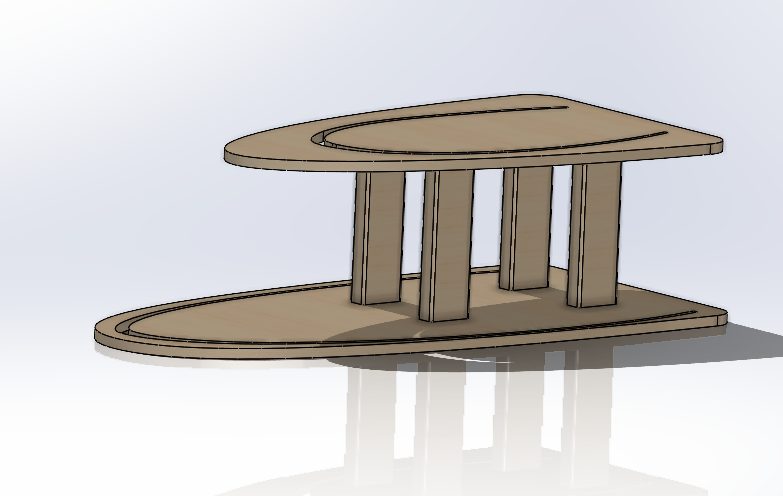
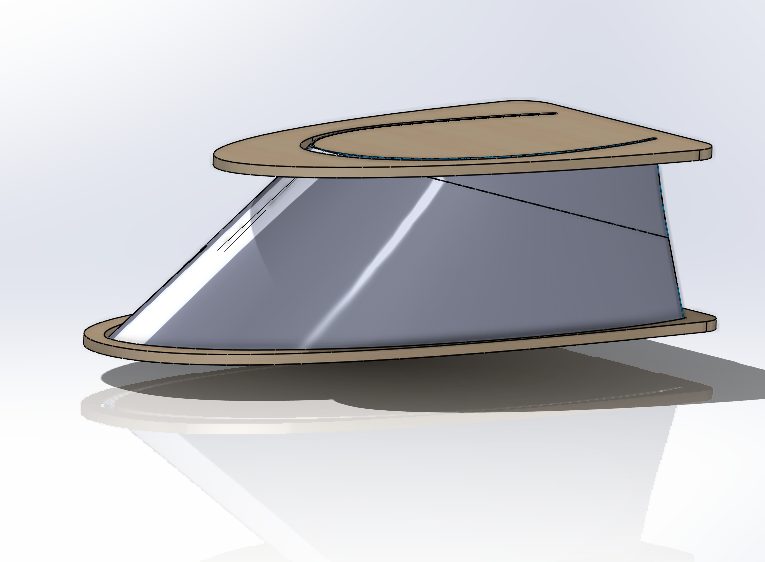
As a backup option, we attempted to develop an in-house thermoforming method using a custom jig. The first jig consisted of:
- Water-jet cut wooden panels forming the structural frame
- A flexible aluminum sheet acting as the forming surface
- Polycarbonate sheet positioned vertically for heating
- Heat gun used as the primary heat source
The intended process was to heat the polycarbonate until it reached its glass transition temperature (approximately 140 to 150 degrees C) and allow gravity to form the sheet over the aluminum mold. However, this initial test revealed several major issues:
- The polycarbonate did not deform sufficiently under gravity alone, requiring manual force.
- Localized heating caused material distortion and optical defects, violating visibility requirements.
- Uneven heating led to degradation and bubbling when temperatures exceeded approximately 180 degrees C.
Temperature monitoring with a thermal gun proved unreliable, making it difficult to control the heating process accurately.
Method Testing
To improve the process, we conducted several targeted experiments to better understand how polycarbonate behaves during heating.
- Force bending test: heated sections of polycarbonate were manually bent to confirm that a clean bend could be achieved with sufficient heat.
- Gravity forming test: the polycarbonate sheet was suspended horizontally and heated from both sides to test gravity assisted forming. This resulted in severe bubbling and uneven deformation, confirming that gravity alone would not provide reliable forming.
- Aluminum sandwich method: a new method was tested by clamping polycarbonate between two aluminum sheets and bending the aluminum with clamps into the desired curvature. Heating the aluminum evenly transferred heat to the polycarbonate, producing a clean and controlled bend with minimal distortion.
This experiment demonstrated a viable low cost alternative to industrial thermoforming.
Thermoforming Test (Jig 2)
Based on the successful aluminum sandwich test, we redesigned the jig to incorporate this method. Key improvements included:
- A second water-jet aluminum sheet to emulate the sandwich method above and clamp the polycarbonate between two metal surfaces
- Vice grips and screws used to maintain the aluminum curvature during heating
- Repositioned structural supports to allow heating from both sides
- Removal of painted surfaces to prevent thermal degradation
This configuration allowed more uniform heat distribution across the polycarbonate sheet.
The Outcome
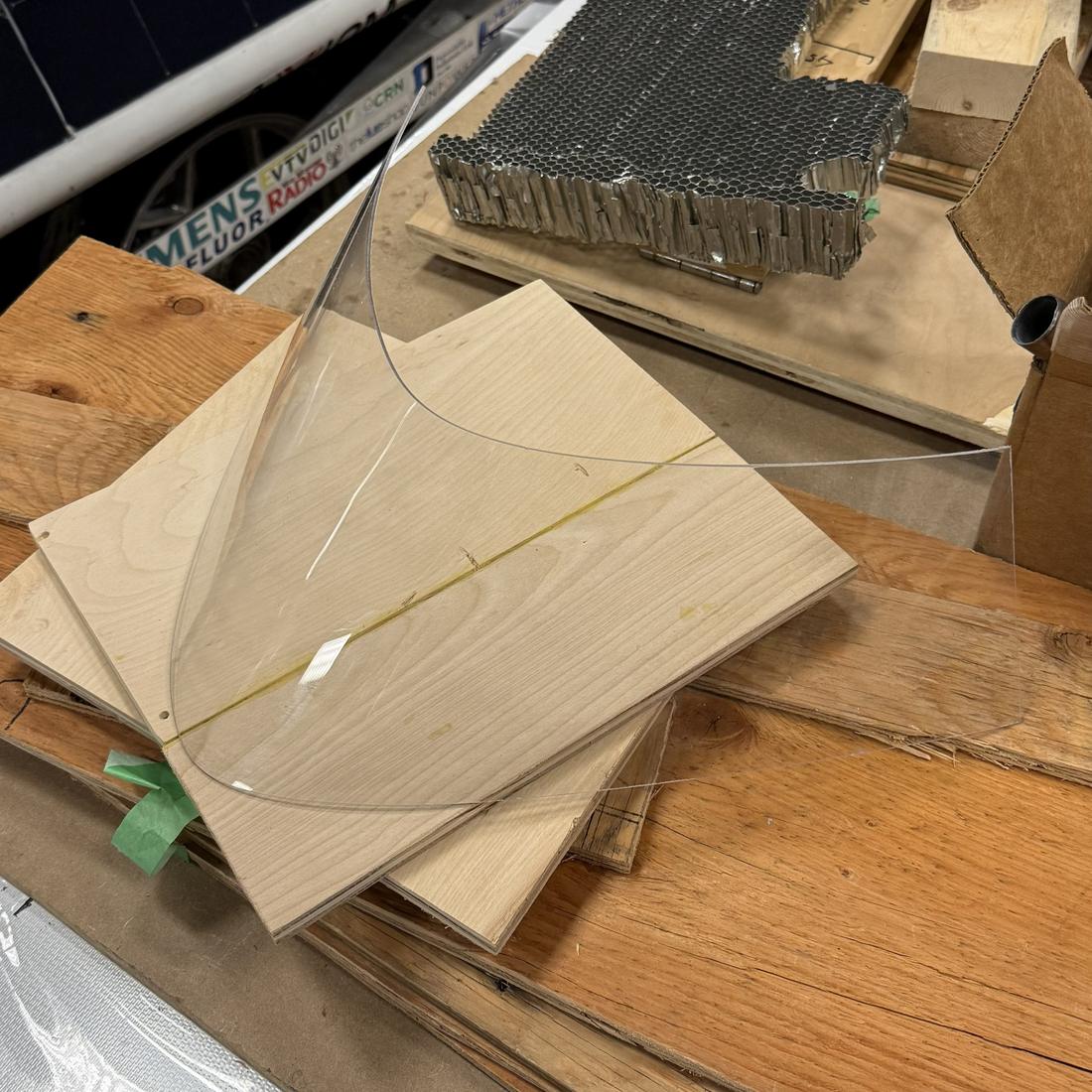
The second thermoforming test produced a significantly improved windshield prototype. Key results:
- Consistent and clean curvature across the windshield
- Minimal optical distortion within acceptable visibility limits
- No material degradation or bubbling
- Demonstrated feasibility of low cost in-house thermoforming
However, the process revealed another major limitation: temperature monitoring. The thermal gun measurements were inconsistent and underestimated the internal polycarbonate temperature, making it difficult to determine when the material had reached its forming point.
Reflection and Next Steps
Although the second prototype was successful, several improvements were identified:
- Implementing a more accurate temperature measurement method to monitor internal material temperature.
- Redesigning the jig to produce a tighter curvature matching the updated canopy geometry.
- Scaling the process to test full size windshield forming.
Beyond the forming trials, I designed the full size forming jig that produced the windshield fitted to the car. The windshield surface itself required advanced surfacing techniques in SolidWorks to hold a smooth compound (double) curvature across the canopy to aeroshell transition while remaining formable from flat sheet, balancing optical quality and aerodynamic continuity against what the in-house thermoforming process could reliably produce.