Aeroshell CFD (Catamaran Body)
Contributed to a body geometry change and CFD analysis that corrected the solar car's predicted drag and lift.
Scope: Contributor, mechanical design and body geometry change, mesh refinement, ran simulations, post-processed results. Tool: ANSYS Fluent. Team: UBC Solar aeroshell subteam.
Overview
This project analyzed the aerodynamics of the UBC Solar catamaran body using a steady RANS CFD model in ANSYS Fluent (k-omega SST), run at 23 m/s with drag and lift referenced to the 0.985 square meter frontal area. I contributed as part of the aeroshell subteam across the mechanical design and the CFD work: I helped develop a change to the body geometry, refined the mesh, ran simulations, and post-processed the aerodynamic results.
Body Geometry Change (the driver of the result)
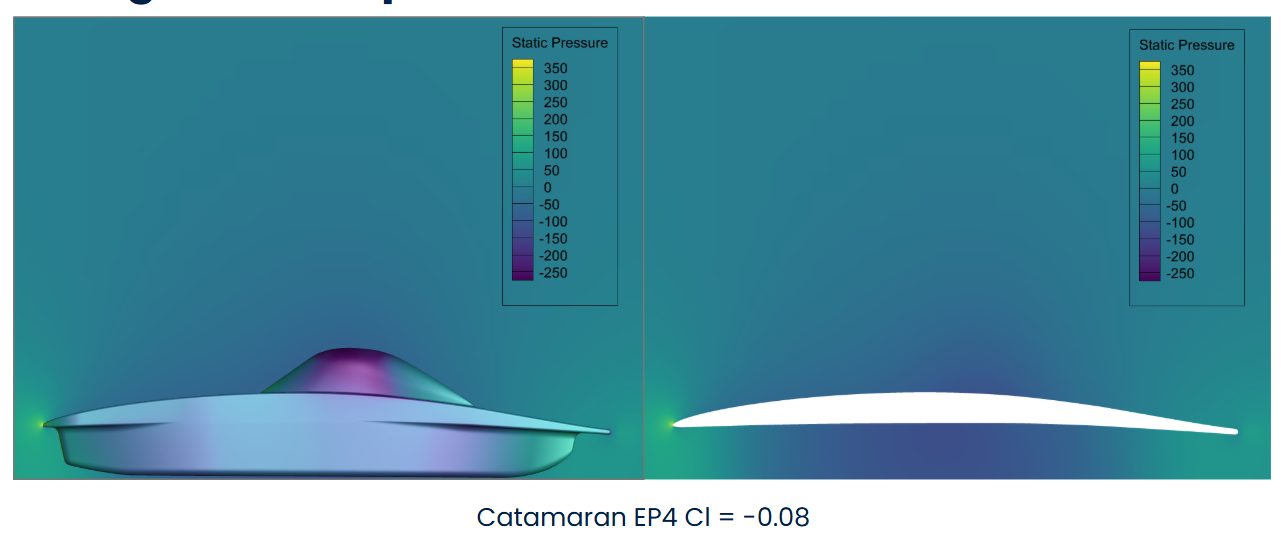
The corrected drag and lift predictions came primarily from a change to the car's body, a team effort that reduced frontal area and curved the front of the body further down. This reshaping was the dominant cause of the improved coefficients, not the meshing. Between the design iterations, the predicted drag coefficient moved from 0.176 to 0.128 and the predicted lift coefficient from -1.0 to -0.55, where negative lift is intended downforce on the catamaran body.
Mesh Refinement (fidelity, not the cause)
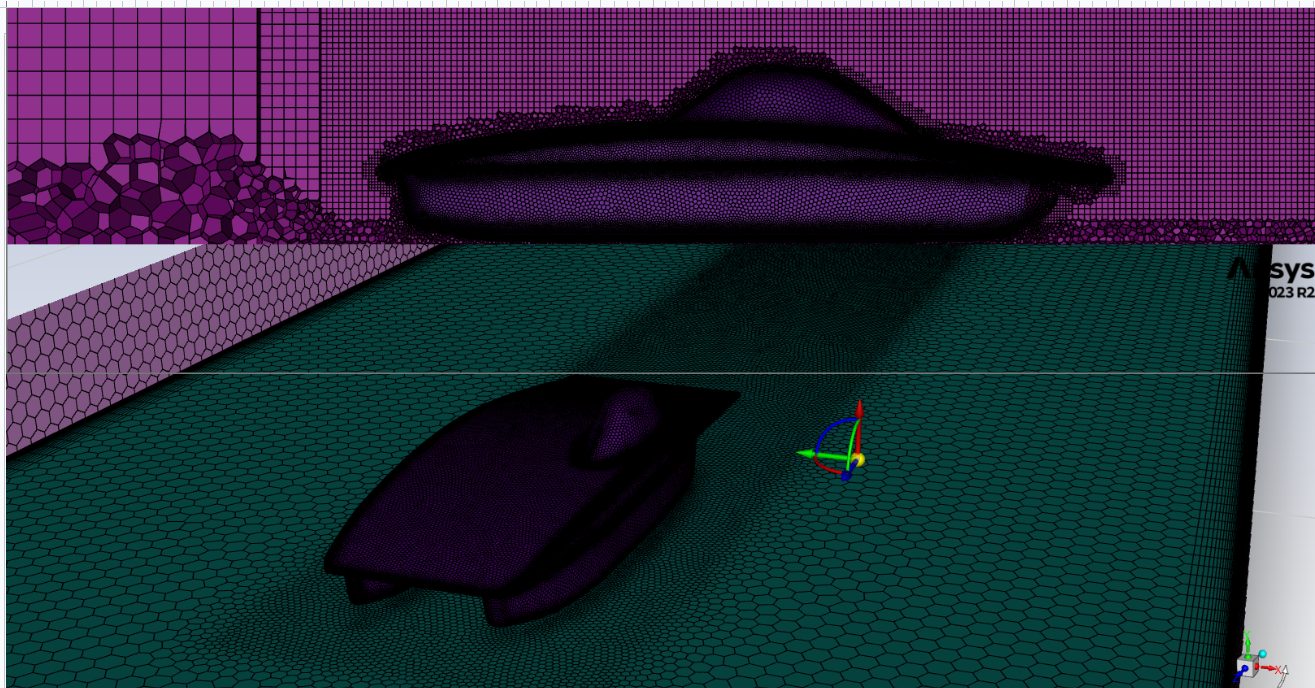
Separately, I contributed to the refinement of the CFD mesh to make the prediction trustworthy rather than to change the numbers. The mesh went from roughly 2 million cells with 3 inflation layers and a y+ range of 1 to 500, where the near-wall region and flow separation were poorly resolved, to 8.9 million cells with 24 or more inflation layers and a controlled y+ of 0.5 to 5. This resolved the near-wall flow and improved separation accuracy, but it changed the force coefficients only by a small amount. Its value was confidence in the result, not the result itself.
Outcome and Honest Limitations
The refined, better resolved model gave the team reliable pressure distributions and force predictions to compare body geometries against. The headline improvement in drag and lift is attributable to the body change; the mesh work confirmed it was real rather than a meshing artifact.
On validation: the model has not yet been validated against physical or wind tunnel data, so the coefficients rest on the CFD setup and near-wall resolution rather than experimental agreement. A formal mesh independence study and physical validation are the natural next steps.